
Edinburgh International Conference Centre (EICC), Scotland, 1–4 November 2026
If you are a Marvel Avengers fan or have recently been watching VisionQuest on Disney+, you will probably be familiar with Vision, a synthetic being created from the famous Ironman’s computer genius JARVIS (aka J.A.R.V.I.S.), with memories but no emotions attached to them. In this Disney+ series, Vision consults the various artificial intelligence (AI) personas (J.A.R.V.I.S., E.D.I.T.H., F.R.I.D.A.Y., and a reimagined Ultron), trying to figure out which voice actually matters and what he is supposed to do with all of them.
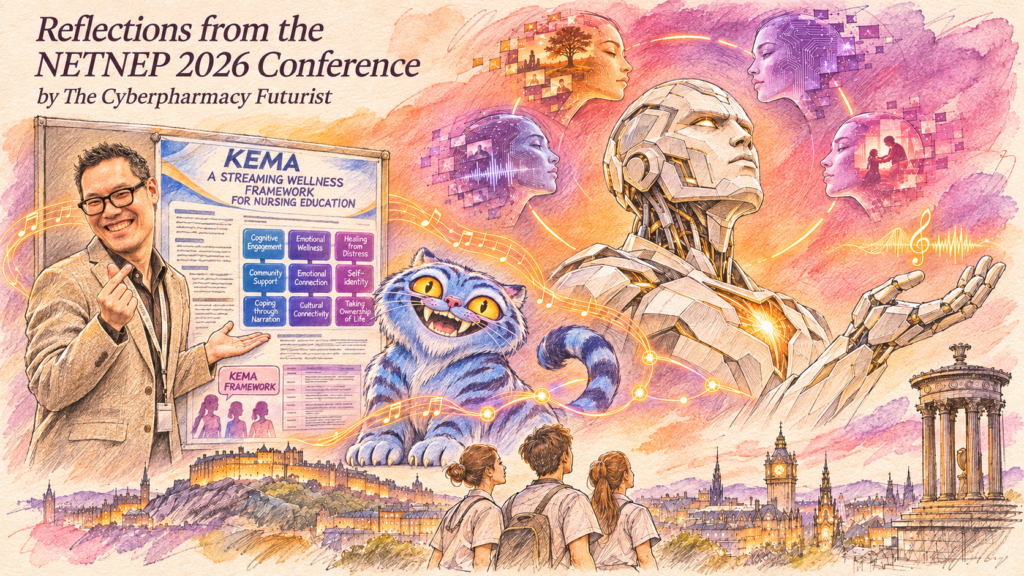
Over the 4 days of the International Nurse Education Conference (NETNEP26) at the Edinburgh International Conference Centre (EICC), it felt like a version of this. There were many presentations and sessions on the use of AI, all promising to transform nursing education – AI chatbots, digital avatars, virtual reality (VR) simulations, escape rooms, and clinical reasoning scaffolds. Seems like the whole world has gone into the AI era.
Here’s my reflection. These reflect my own personal views and opinions, and are not representative of any group or organization.
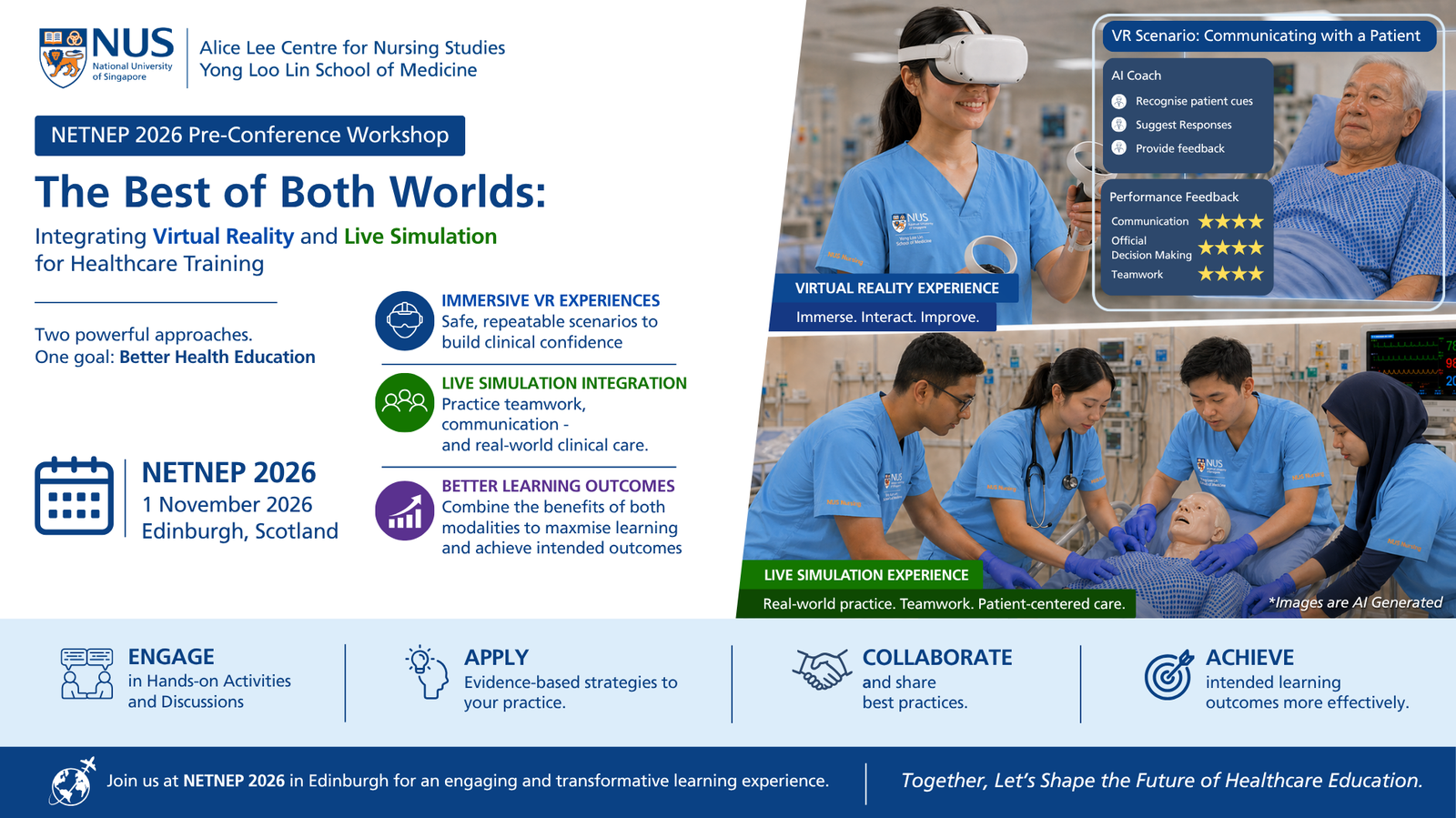
Getting the Best of Both Worlds: ALCNS Pre-Conference Workshop
Before the main conference, our team from NUS Alice Lee Centre for Nursing Studies (ALCNS) ran a pre-conference workshop on 1 Nov 2026 (2–5pm GMT). There were ~65 registered participants from all over the world, including Canada, Austria, Portugal, Turkey, and beyond!
Showcasing the VR and simulation work done in the department, it was a session with presentations and 5 rotating stations of hands-on:
| Stations |
|---|
| Immersive 360° learning experiences |
| IV procedure in VR |
| VR-augmented mental health scenarios |
| AI-assisted clinical simulation (my station) |
| Virtual escape room scenario in an education environment |
The participants were busy trying out the various simulations on laptops and VR headsets during this workshop. I was with the guys at Station 4: MAGICS, (a nursing PhD project). Lots of interest, lots of good questions. Being a newbie to the nursing team and in the department, the workshop definitely opened my eyes, in a good way. I was impressed by the innovation and research work done within the department.
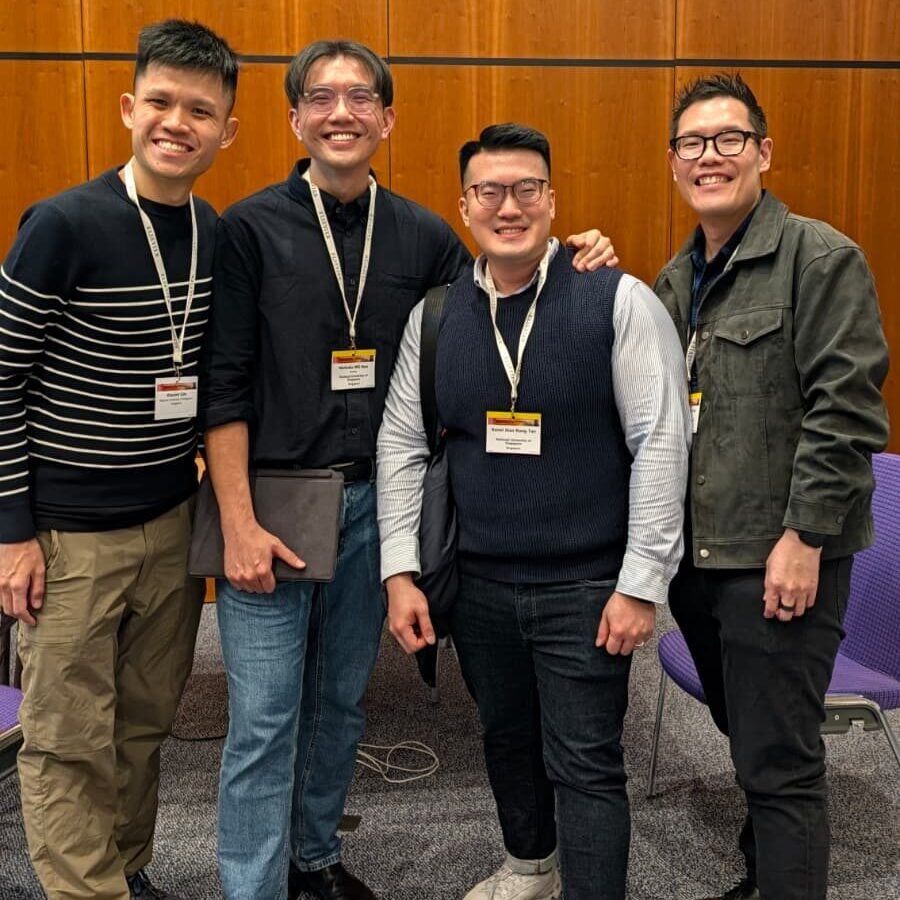
Nursing Is Not Just About the Workforce… It is a Strategy.
The opening keynote was from Aisha Holloway, the Chief Nursing Officer for Scotland. Her argument was that nursing has long been focusing on what the profession lacks (e.g. staff, resources, recognition). But there must be an intentional shift in thinking – to start with the solution rather than the problem, and then work backward. She also emphasized the need for practical backing for policy priorities, including but not limited to, targeted investment and country-led collaboration across government sectors, and relevant partners. To achieve the strongest impact, there must be greater coordination and collective effort.
Speaking on the difficult topic of negotiation, trust and cross-sector collaboration, she gave a “balcony” and “bridge” analogy – stepping back to reflect on our own approach (balcony), then actively building connections (bridge). Ingredients for collective work include curiosity, creativity, collaboration and “people power”. She called for inclusive participation, shared responsibility, and dialogue with communities.
The last part of her keynote emphasized the need for emerging leaders among early-career nurses, and the opportunities for them to take on leadership roles. She highlighted storytelling as a way to build understanding and support, and advocated generational responsibility – where established leaders needed to actively make space at the table for early-career nurses to create knowledge and lead change.
Presenting an Emotionally Demanding Topic through Artistic Inspiration
Dr. Kendra Rieger (Trinity Western University, Canada) presented her participatory action research on art-based, indigenous-led workshops that helped nursing students engage with Canada’s Missing and Murdered Indigenous Women and Girls (MMIWG) crisis. Across 3 workshops for undergraduates at 3 Canadian universities, the project showcased how art-based education could enhance nursing students’ understanding of MMIWG, through different art forms: soil art, teardrop art, and the Red Willow Fish Trap Woman.
Through lived experiences, personal storytelling and the inspiring artwork, the research team was able to create culturally safe spaces for engaging with difficult topics with indigenous groups. This type of experiential learning was something students found useful, outside of just learning from videos and statistics. The researchers suggested that decolonization should be affective as well as intellectual. The participants who engaged through art, story, and ceremony developed a sense of meaningful empathy and personal responsibility, which could potentially translate to providing culturally safe care.
An interesting, but heavy topic indeed…
The Flood of AI Voices and Gamifications
I have to say that by Day 2, I already had a deja vu feeling from hearing presentations about AI chatbots, VR simulations, and escape rooms. While I list some of the sessions here, these are by no means exhaustive, nor presented in any particular order…
AI Patient Chatbots for Practice: This project at the University of Technology Sydney used AI chatbots in the form of patient personas to teach clinical communication and clinical reasoning in a second-year clinical subject. The project involved over 600 nursing students, who interacted with a patient persona, received automated feedback, and then were assessed through another AI conversation with another persona, with submitted documentations and reflections. Key takeaways: a safe learning environment, confidence and critical thinking, and self-reflection and growth, but AI literacy needs to be taught explicitly, not assumed.
AI-enhanced Simulation vs Scripted Simulation: This wa an experimental study funded by EU/Italian Research Council, which compared 3 approaches using the same scenario – traiditonal mannequin simulation, scripted VR simulation and AI-enhanced VR simulation. The interesting thing was that the AI-enhanced VR did not produce significantly better clinical reasoning gains compared to the scripted scenario. While the students found the AI version more cognitively demanding, that did not translate to better reasoning outcomes. Take home message: pedagogical design matters more than technological sophistication.
The Many Faces of Escape Rooms: The Royal Children’s Hospital (Melbourne, Australia) co-designed an escape room to enhance psychological safety through gamified, immersive scenarios. Another Portuguese study developed a clinical escape room for students in an advanced obstetric emergency course, based on the World Health Organization’s safe childbirth checklist. Evaluations involved mixed-method approaches including participant satisfaction surveys, validated instruments, and of course, evaluation of the learning objectives. But what struck me about these presentations were that while the concepts and approaches were interesting because they were gamified, actually, there were no serious games pedagogies (or even escape room pedagogies) that were applied – it seemed that the research teams had just put in clinical or content puzzles within a virtual “room” environment – and this because an escape room as participants had to “escape” from the “room”.
Gamification Review: In a review of 23 studies across 11 countries, the researchers found that feedback, progression, narrative, and contextualization were common gamification elements in nursing interventions; while objectives, challenges, social interaction and collaboration were less common. Interestingly, teamwork, communication, ethics, empathy, confidence and professional attitudes were lacking in nursing game studies – considering the fact that these skillsets are meant to be core to the healthcare professions. Key takeaways: healthcare/nursing professions are still using gamification (and I loosely use this term to include anything related to gaming) to measure knowledge and skills, than attitudes and behavior.
Spotlight: When (My) PhD Student Steals the Session
Surprisingly, the presentation that I enjoyed most at NETNEP was not a keynote or plenary, but a 30-minute oral presentation in Fintry Room on Day 4. Just so happened that it was from my PhD student!
Dr. Rooma Panchmatia (Alice Lee Centre for Nursing Studies, NUS) presented her topic on: “Development of an EPA-informed artificial intelligence (AI) chatbot to scaffold clinical reasoning skills in nursing education” (O56.1). Clearly wow-ed the audience among the sea of AI chatbot studies at the conference…
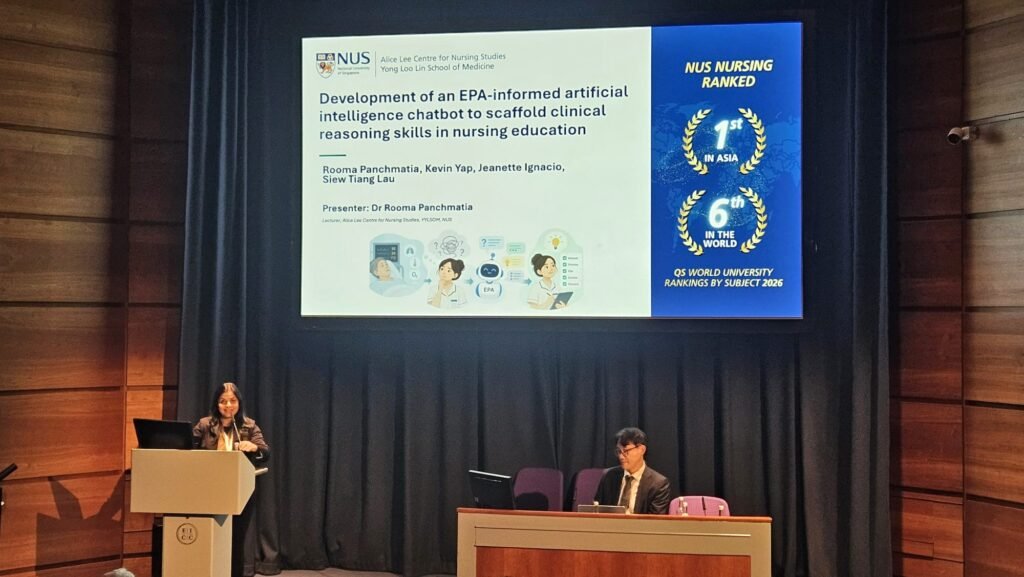
The concept (which seemed to even be advanced in certain countries) was about structuring an AI chatbot around a set of clinical competencies known as Entrustable Professional Activities (EPAs), so that nursing students can practice independently after they graduate.
Through different levels of scaffolded prompting, the AI chatbot would be able to train on clinical reasoning. The analysis of student-chatbot response transcripts was where the Q&A got lively and interesting. The audience wanted to know: how was the chatbot evaluated? How were hallucinations managed? How were the clinical cases/scenarios developed? (I particularly liked the answer of developing the bot “step-by-step” like writing a “clinical drama”…) Will the institution keep going in this direction?
But what really wow-ed the audience was not the findings. It was the clear explanations by Rooma on what EPAs are, how are they relevant to nurses how and why the scaffolding was structured the way it was, and how the transcript analysis showed that the chatbot was doing what it was supposed to do… I especially liked the animations of the tons of excel sheets piled on top of each other to show the intensity and detailed analysis of the work done.
Fielding a room full of inquisitive and intelligent questions from academics is tough, and I’m glad that Rooma was able to answer with clarity the full repertoire of questions from the audience – ranging from EPAs and clinical reasoning theory, to prompt engineering techniques and methodology, as well as application in educational practice.
Definitely a good way to end the ALCNS presentations at the conference!
The Echo of What Everyone Was Thinking
The closing Keynote by Sonia Kelly (Cleveland Clinic London, UK) was aptly entitled: “From Fear to Possibility: The Future of Nursing and Midwifery Education in an AI-Enabled World”. Key take home message: educators should redesign assessments to build AI literacy, and prepare learners to question technology, while preserving human judgment and care.
Her emphasis: technology must support professional care, not replace it. AI may change how work is being done, but healthcare still depends much on our human qualities – empathy, trust, advocacy, contextual understanding and sound judgment. Educators need to have practical AI literacy, not technical expertise. The curiosity to build our own AI literacy is not through courses, but through small experiments: try, debrief, adjust, try again…
The question the profession should be asking is whether nursing education is preparing students for an AI-enabled future, or are we still optimizing for the past…
My Contribution to NETNEP26: #KPopDemonHunters at P2.128
In a conference full of AI avatars and clinical simulations, a poster about K-Pop animated films definitely pulled in some intriguing and curious stares, with some delegates walking past who could not resist taking a picture shyly – presumably to send to their kids, hashtagging the famous Netflix movie. Most were surprised that a piece of research could even be generated with the title: “Can you fight your demons with (KPop) Demon Hunters? A streaming media wellness framework for nursing education“.
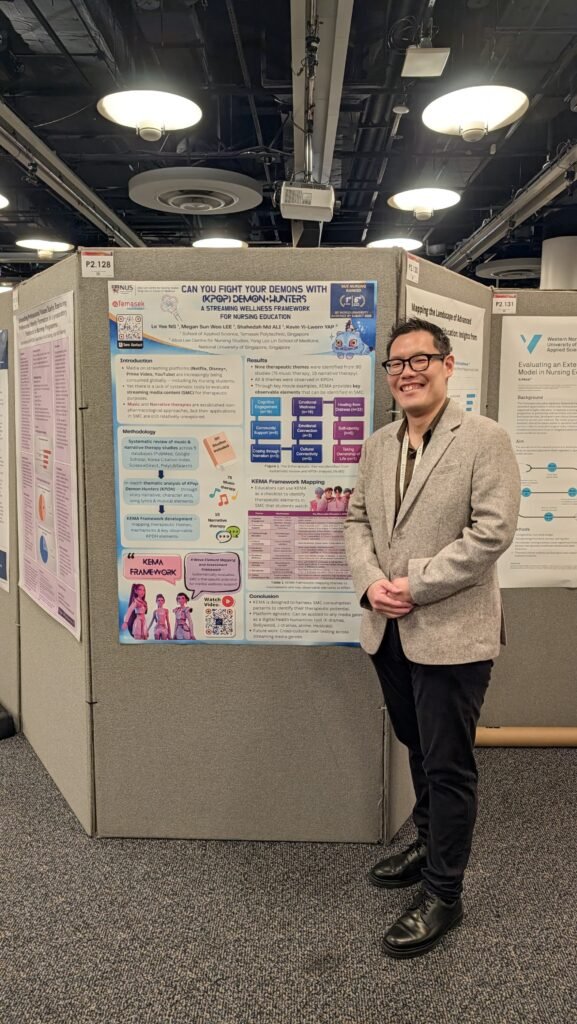
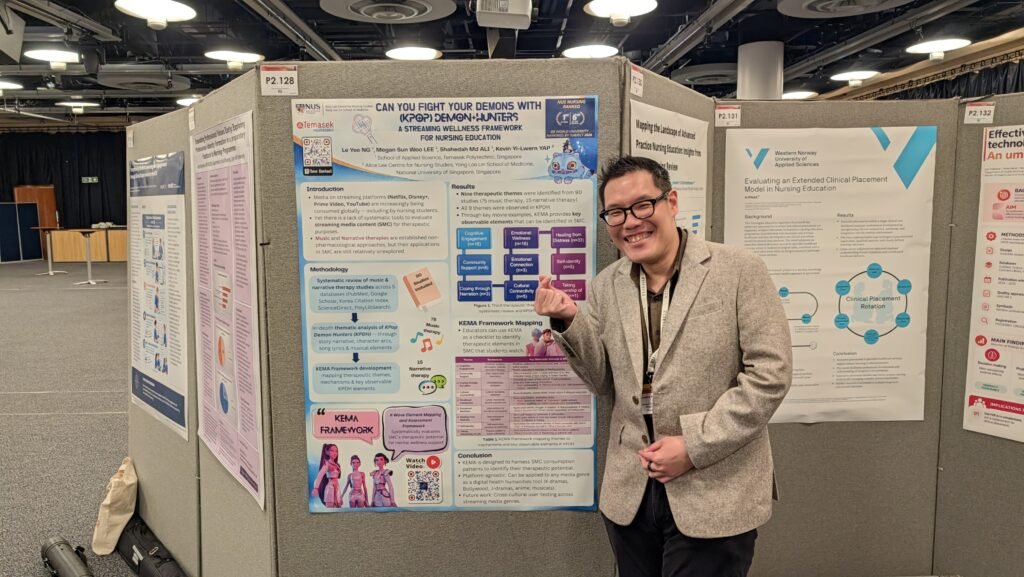
Our evidence: built from a systematic review of 90 studies across music and narrative therapies, this project identified 9 therapeutic themes with mechanisms identified from literature, and mapped them to key observable elements in last year’s most-watched animated original in Netflix history with over 500 million views.
The framework developed in this project is platform-agnostic, and can be adapted as a resource for mental health nursing modules or student wellness initiatives. The goal is a digital health humanities tool that meets students where they already are.
So Did We Find Our VisionQuest?
Vision’s problem in the series is not about the lack of AI voices. In fact, he has too many. His problem is knowing which one to trust, and working out what he actually values.
And it’s the same with NETNEP26. The simulation world… The AI flood… The key is finding a clear and appropriate signal among the sea of static tech noise that the healthcare sector and nursing profession are facing.
Edinburgh was cold. But the ideas were not. My takeaway: the tech is only as good as the educational thinking behind it.